Navigating Your SAP Data Strategy in 2026: Practical Paths and Key Decisions

14 November, 2025
– Nick Bell, CEO, Decision Inc.
If you are an SAP customer, you are likely feeling the pressure to make some big decisions about your data strategy. The landscape is changing fast, and with SAP’s Business Data Cloud (BDC) now bringing together your analytics and AI platforms, Datasphere, BW, and SAP Analytics Cloud (SAC), plus native integrations with Databricks, Snowflake, Google BigQuery and Microsoft Fabric, there is a real opportunity to future-proof data platforms for analytics and AI.
The Current State of SAP Data in 2026
SAP has taken a big step forward by unifying its data offerings into the Business Data Cloud. This is not just another tool, it is a fully managed, single-contract SaaS solution that brings together the business logic of Datasphere, analytics and planning in SAC, modernisation paths for BW, and a built-in SAP Databricks service for AI and data engineering. The goal? To move away from fragmented, siloed tools and toward a governed, business-centric data fabric that makes it easier to share, model, and trust your data.
Some of the most exciting updates rolling out in 2026 include:
Seamless planning between SAC and Datasphere, which means you can now use a single model for planning and analytics, with end-to-end governance.
If you are still running BW 7.5, you will want to pay attention, mainstream maintenance ends in 2027, and while extended support is available until 2030, it comes at a premium.
SAP is offering “lift and shift” options to BW PCE within BDC, as well as BW Bridge to help you reuse existing extractors and content while moving toward a modern data product model.
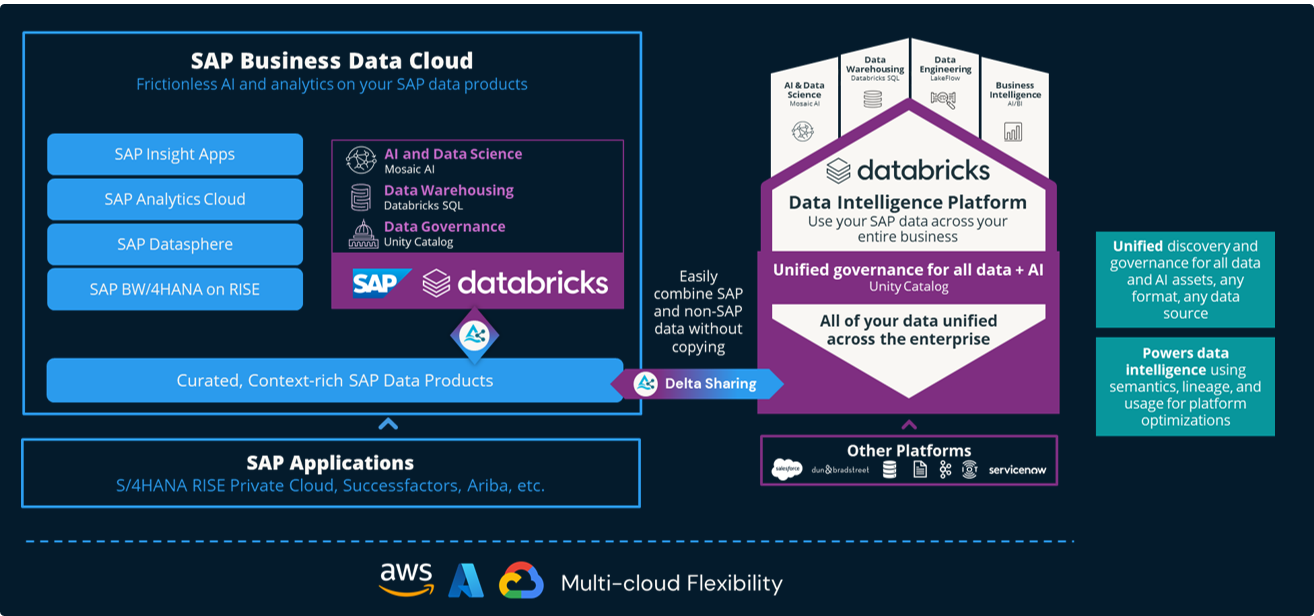
And for those looking to accelerate AI and machine learning, SAP Databricks, Snowflake, Google BigQuery, and Microsoft Fabric are now generally available within BDC, supporting bi-directional, zero-copy data sharing and native governance. This means you can build AI/ML models without duplicating pipelines or data, saving time and reducing complexity.

Why BW Modernisation Cannot Wait
For many organisations, the decision to modernise their data strategy is no longer just about optimisation, it’s about risk mitigation. The end of mainstream maintenance for core legacy platforms like BW 7.5 and BW/4HANA 2021 is set for December 31, 2027. While extended maintenance is available until 2030, it comes with a premium cost, making it a significant factor in your total cost of ownership.
If you are still running older BW environments, now is the time to start planning your transition. SAP BW/4HANA will be supported until 2040, but for those on older versions, the need for a clear strategy is urgent.
♦ This means taking stock of your current data assets, defining your goals, establishing governance, and designing your future architecture.
The good news is that the extended maintenance window gives you time to plan and execute a phased migration, minimising operational risk while the BDC ecosystem continues to mature.
The Business Data Fabric: Connecting ERP, Analytics, and AI
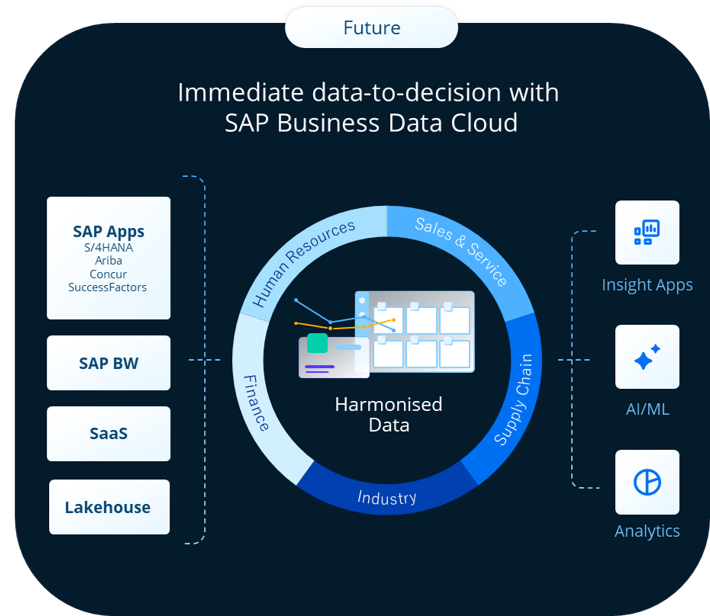
The business data fabric is at the heart of SAP’s new approach. It enables real-time connectivity across hybrid and multi-cloud environments without the need for data duplication. This unified platform connects all your SAP and third-party data in a managed SaaS solution, making it easier to discover, share, and model data.
One of the most powerful aspects of this architecture is its role as the foundation for generative AI.
By linking data, metadata, and business processes through a knowledge graph, the platform ensures that AI models are grounded in trusted, context-rich data.
This is essential for creating reliable and responsible AI applications that truly understand your business.
What’s New in SAP Data for 2026?
One of the standout features of the BDC and Databricks partnership is Delta Sharing, also known as zero-copy sharing.
This technology transforms data architecture by allowing direct access to data without physical replication or complex ETL pipelines. Data products created and governed within Datasphere are stored as Delta files in the SAP object store, and SAP Databricks, Snowflake, Google BigQuery, and Microsoft Fabric can read these files directly, securely, and quickly.
This approach not only reduces storage costs and network fees but also eliminates the need for complex ETL pipelines.
Data scientists can build AI/ML models in SAP Databricks, Snowflake, Google BigQuery, and Microsoft Fabric and share the results back to Datasphere for harmonisation and business consumption, dramatically reducing data latency and the risk of inconsistencies between operational and analytical layers.
Both platforms empower organisations to move from fragmented, reactive data systems to unified, intelligent environments that accelerate AI adoption.
How Companies Are Navigating Their SAP Data Transformation
There are several realistic paths companies are taking to modernise their SAP Data Strategy:
Datasphere-First (Business Data Fabric) with SAC
Adopting Datasphere as the foundation for analytics and planning, with SAC for business insights.
Stay and Optimise on BW, then Modernise via BDC
For those not ready to make a full leap, optimising existing BW environments and then transitioning to BDC is a common approach.
Business Data Cloud as the Strategic Landing Zone
Using BDC as the central hub for all data and analytics needs.
Hybrid Multi-Platform
Operating a mix of platforms to meet diverse needs.
SAP Databricks, Snowflake, Google BigQuery and Microsoft Fabric for Advanced Analytics and GenAI
Leveraging these native integrations for large-scale AI/ML and advanced analytics.
Key Considerations in the Transformation Journey
Modernising your SAP data landscape requires a clear roadmap that balances timing, governance, and technology choices to ensure a smooth, value-driven transformation.




Build for AI Readiness: Use SAC + Datasphere for governed analytics and SAP Databricks, Snowflake, Google BigQuery, and Microsoft Fabric for large-scale AI and ML.




With a clear transformation roadmap in place, organisations must also evaluate the cost, risk, and value factors that shape the long-term success of their data modernisation journey.
Cost, Risk, and Value Considerations
Successful SAP data transformation requires balancing investment, governance, and business impact, ensuring every step delivers measurable value while minimising risk.
- 1. Understand Cost Drivers: Manage data volume, integration scope, and rewrite vs. reuse to control migration effort and cost.
- 2. Leverage BDC TCO Benefits: Reduce patching and replication costs through zero-copy sharing, storage offload, and simplified upgrades.
- 3. Mitigate Risks Early: Strengthen data quality, retention, and governance frameworks before migration to ensure continuity and trust.
- 4. Accelerate Value Realisation: Unlock faster planning cycles, governed self-service, and AI/ML insights on curated data products.
- 5. Drive Smarter Decisions: Improve agility and decision velocity across functions with consistent, trusted business data.
How Decision Inc. Supports SAP Data Transformation
Decision Inc. is dedicated to guiding organisations through complex data and analytics transformations, ensuring that vision is matched by effective execution.
By working closely with clients, the Decision Inc. team brings both strategic expertise and practical, hands-on support, helping you rethink your data strategies, speed up analytics deployments, and build strong governance frameworks that last.
Whether you are just beginning your journey with SAP Business Data Cloud (BDC), looking to modernise your existing BW environment, or laying the foundation for AI and advanced analytics, Decision Inc. provides proven accelerators and a results-driven approach every step of the way.
Here’s how Decision Inc. can help:
-
- ♦ Strategy and roadmap development aligned to S/4HANA and AI priorities.
- ♦ BW modernisation with lift-and-shift and BW Bridge implementation.
- ♦ Business Data Fabric enablement via Datasphere governance and self-service.
- ♦ Planning and insight app deployment using SAC and Datasphere integration.
- ♦ AI/ML readiness and development with SAP Databricks, Snowflake, Google BigQuery, and Microsoft Fabric support.
- ♦ TCO optimisation through platform rationalisation and zero-copy integration.
Invitation: Let’s Shape Your SAP Data Future
We invite you to meet with us and explore how a focused 4–6 weeks SAP Data Strategy and BW Modernisation Platform can shape your organisation’s path forward.
During this engagement, we’ll help you
- ♦ define your ideal BDC/Datasphere strategy,
- ♦ outline a BW reuse plan,
- ♦ establish a governance model, and
- ♦ assess your AI readiness,
all supported by a sequenced roadmap and compelling business case.
Let us collaborate to align your operating model, platform choices, and migration approach. With our support, you will realise meaningful value faster while avoiding unnecessary rework and added costs.
Reach out to schedule a conversation, let us design your
SAP data future together.